Category Archives: Weather

Chesapeake Bay Skipjacks

My fascination for oysters didn’t kick in until I moved to Hatteras Island. Starting out, times were tough financially, but it was a worthwhile tradeoff for the experiences in store for me. Back then you could walk the shore of the Pamlico Sound and get all the oysters you wanted for great meal. I remember picking them with Larry Midgett and some of the other locals, and it became one of my favorite things to do.
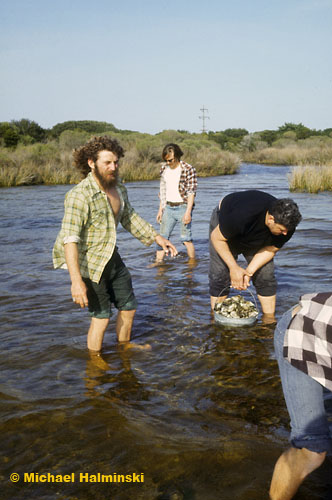
larry1

Larry Midgett, Tim Merritt and “Big Leroy” picking some oysters in a creek in 1974. Today this creek on Hatteras Island doesn’t produce much anymore.


In the early 80’s, I began going to Easton, MD to participate in a photography exhibit at the popular Waterfowl Festival. During the show in 1981, an acquaintance that I knew through surfing the Delaware shore told me that he was dredging oysters on the Chesapeake Bay Skipjack, Stanley Norman. He invited me out for a sail, so once the festival was over, I took Trent Palmer up on his offer. The wind was light, and so was the oyster catching, but I knew right then that I wanted to spend some more time photographing the only commercial fishing boats in the United States still using sail power. The next day, I returned to Hatteras to resume my life there, still thinking about the skipjacks.
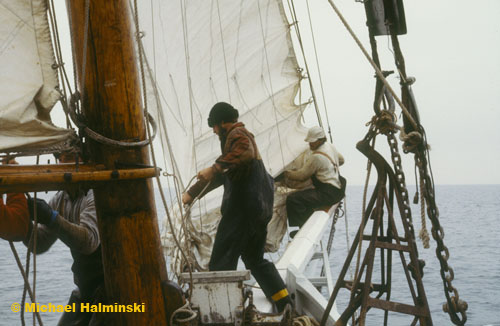
trent1

Trent Palmer out on the bowsprit of Stanley Norman furling the jib in November of 1981.


Later that winter, Trent told me about a couple of boats that had openings for crew members. So I drove to Tilghman Island to see about working on a Chesapeake Bay Skipjack. My intention as a budding photographer was to shoot some of these historical workboats under sail. The only way I could do so, was to seek employment to pay my way. I was a little nervous at first, but once I stepped aboard the Virginia W in the predawn hours, I met Tim Stearns, the owner and captain of the 1902 built skipjack. He didn’t fit the mold of what I expected from a typical sea captain. From the very beginning, he was welcoming, kind, didn’t shout at the crew, and we became very good friends. I was also impressed that this young man of small stature had bought this rotten, derelict boat, and restored it nearly singlehandedly in about a years time. It became a very seaworthy workboat and had a new life once again.
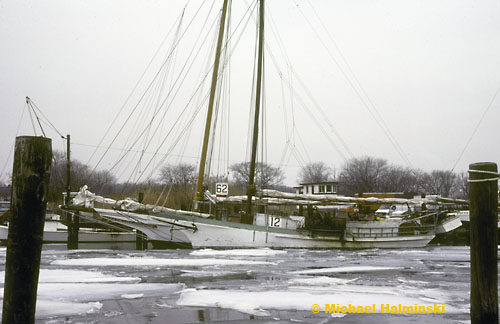
 

virginia-w-at-dock1

Virginia W in port at Tilghman Island rafted up to the Anna McGarvey as ice flows through Knapps Narrows. According to records at the Chesapeake Bay Maritime Museum, she was built in Oriole, Maryland in 1902, and is 44 feet in length.
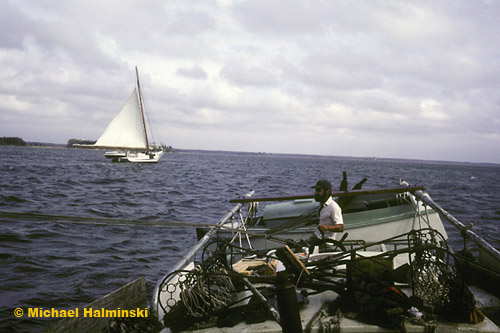
 

virginia-w1

Captain Tim Stearns is at the helm of Virginia W near the mouth of the Choptank River.
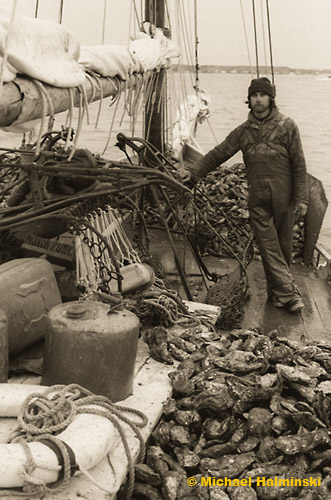
 

mike1

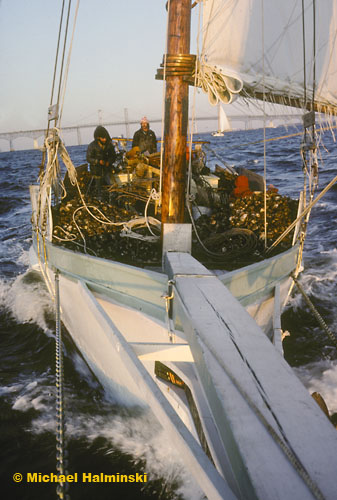
Me the “greenhorn” after a good day of working a muddy bottom. Tim asked me to hand him my camera to take this shot. Then I reciprocated and took his picture amid 120 bushels of oysters. We had a good hard working crew, and I dredged aboard Virginia W for the better part of 2 winters, always with my waterproof Nikonos camera close by to catch those magnificent boats sailing by.
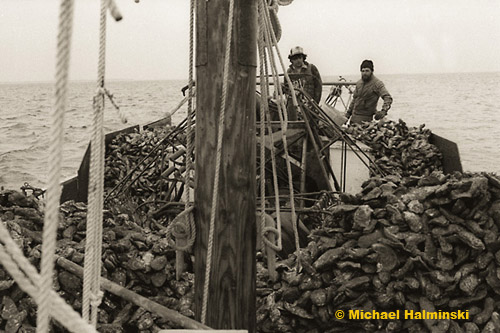
tim2


annapolis1

With the Chesapeake Bay Bridge behind us, I jumped out on the bowsprit of the Virginia W to make this photograph while we sailed into Annapolis. We spent the night on board there with 100 bushels on deck.
lee1

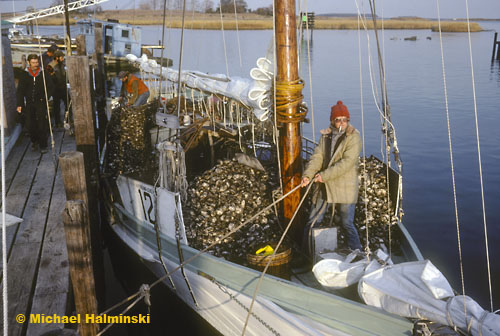
Leigh Hunteman handles the bow line of  Virginia W to shovel out at the dock on Tilghman Island. Leigh later became the only female captain of a skipjack by running the Sigsbee.  
 

stanley-norman1

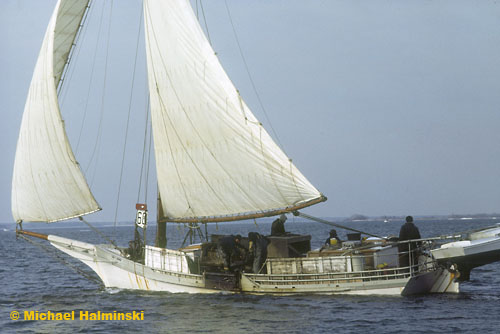
The Stanley Norman was built in Salisbury, MD in 1902 and is 47 feet long at the waterline. Here owner/captain Ed Farley steers her over an oyster bed.
 

sigsbee1

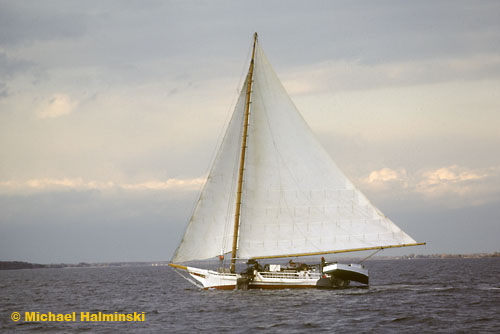
Sigsbee at 47 feet was built at Deal Island in 1901. Here she pulls dredges under full sail, with Captain Wade Murphy at the helm.
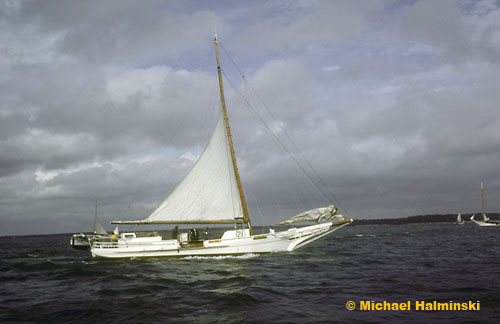
 

kathryn1

The skipjack Kathryn at 50 feet, was built in Crisfield, Maryland in 1901. Her bottom is planked fore and aft with rounded chines, rather than the typical herring bone, hard chined bottoms of most skipjacks. Here she flies by us pulling both dredges, 4 reefs in the mainsail, with captain and owner Russell Dize at the helm.
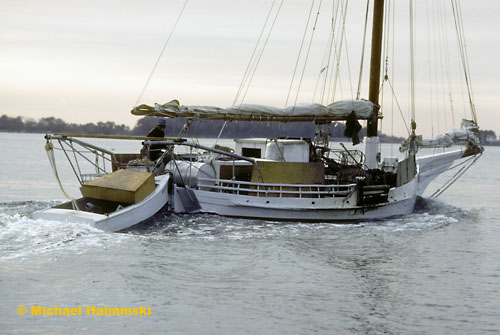
 

claude-w-sommers1

After a day out on the water, Captain Darryl Larrimore guides the 42 foot Claude W. Somers back to port powered by the yawl boat. She was built in 1911. Part of the history of this skipjack is tragic. In 1977, she went to the bottom in a storm near Crisfield, taking all of the 6 crew with her.
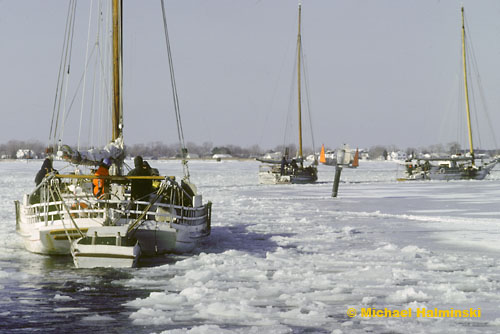
 

ice1

This stern view shows the Kathryn as she follows a path cut by a state ice-breaker in order to get back to port. The temperature was 10 degrees and the ice a foot thick. My feet were still cold despite felt-lined work boots and 2 pair of socks. This was one of the last days of my experience on Chesapeake Bay Skipjacks. Thus ended my career as an oysterman.
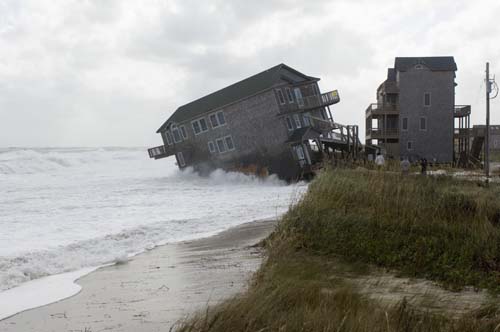
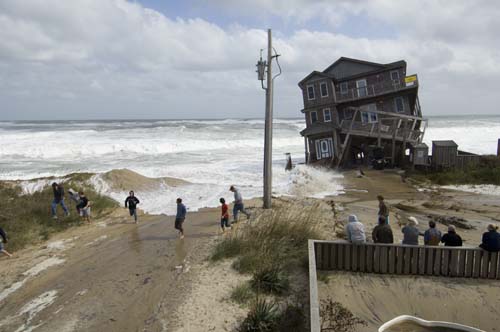
Another One Goes Down

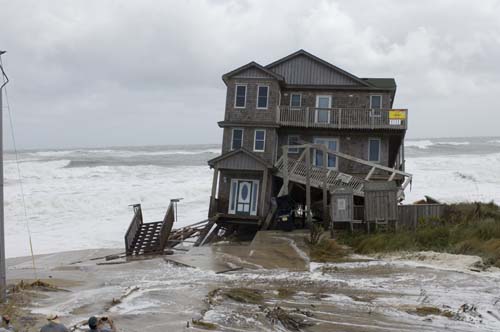
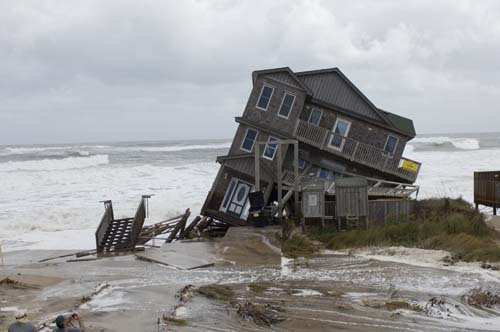
I’ve been watching houses wash into the ocean for years, and it’s always an experience of power. Nothing is permanent near the surf zone. Back in the 70’s and 80’s , I lived in north Rodanthe for over 10 glorious years. Some of the best times of my life were spent there. Storms and shifting sands are a constant. The wind and waves, quite literally shape this place. And nothing stands in the way.

My good friend Joe Kierzkowski will usually give me a call when something of significance is happening. He got me at 4AM when the Bonner Bridge fell down in 1990. And this Sunday, at a more respectable hour, he phoned about a house that was beginning to lean into the ocean.

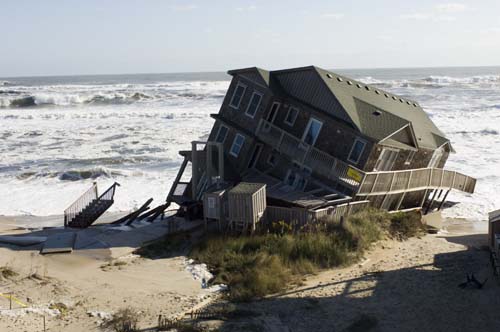
Denise and I got there just as high tide was peaking, and sure enough we were witnessing a big one ready to go down. The McMansion was built on a very dynamic beach only 5 or 6 years ago, complete with pool, jacuzzi and numerous other amenities. I wondered how many flat screen tv’s were inside. And here before our very eyes it’s all going into the ocean. Imagine that!

Every now and then, we could hear the sound of splitting lumber. At one point there was a loud crack when a wave hit. Then the building dropped to one side, another splitting sound and it leaned further. And finally dropping completely off the pilings, and resting on the beach…. all with 10 seconds.

Last night the building survived the following high tide, and is becoming quite a tourist attraction.

My Date with Tropical Storm Hanna

Like most residents of the Outer Banks, I keep an eye on tropical weather system development. This isn’t only due to to survival, but also because I relish these storms as photographic subjects. Recently, Hanna was no exception. Once again, we were fortunate to avoid a direct hit. My sister in Raleigh had more wind and rain than we did.

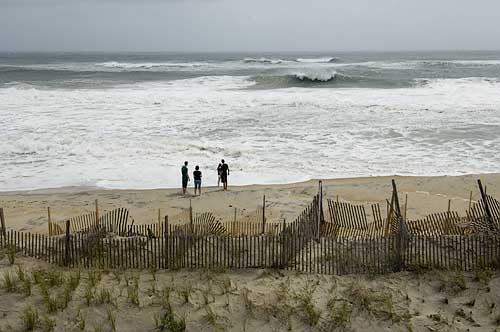
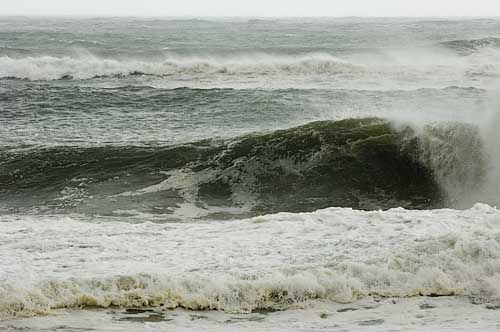
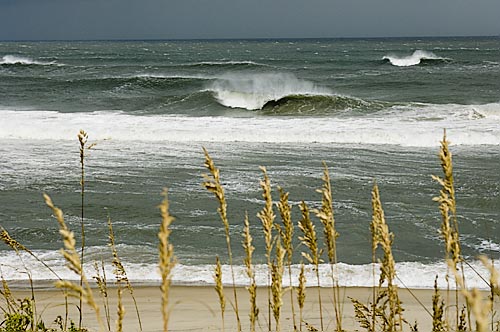
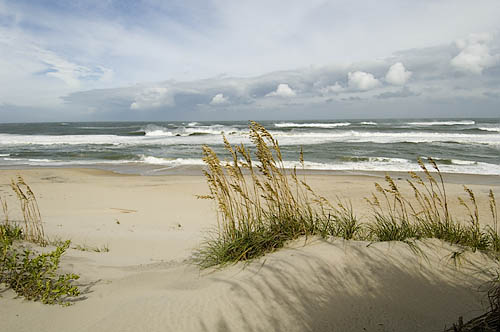
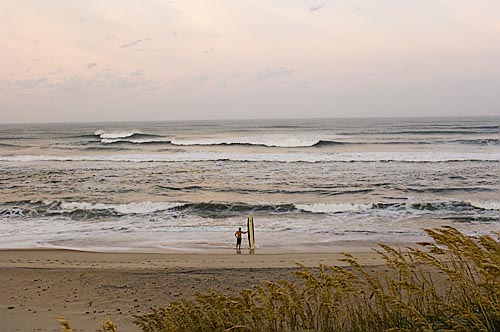
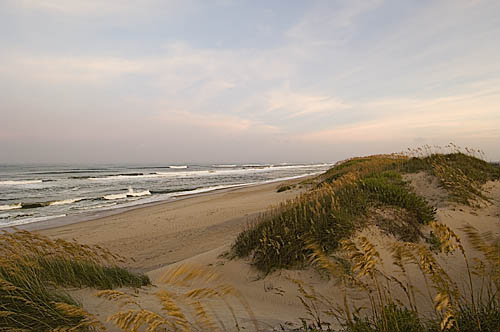
As the storm moved inland up into the piedmont region, we saw large seas and swirling clouds. Strong westerlies brought some minor flooding from the Pamlico Sound. By mid afternoon the skies brightened as my wife and I watched a dark band of rain move eastward over the ocean. The swells cleaned up, and remained strong. I went to work shooting beachscapes on Pea Island, accompanied by Denise.

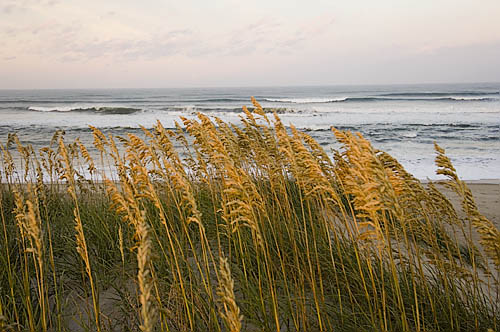
Later that afternoon, the clouds and lighting conditions were setting up for another go. I returned to Pea Island for the end of the day. The ocean and sky were spectacular. After lots of exposures and experimenting with different shots that day, I felt pretty good.

Weather Phenomena

The initial days of August on Hatteras Island, we experienced many short-lived thunder storms, almost daily. In the routine of digital photo editing, more than once I found myself not trusting my surge protector, shutting the computer system down and pulling the plugs.

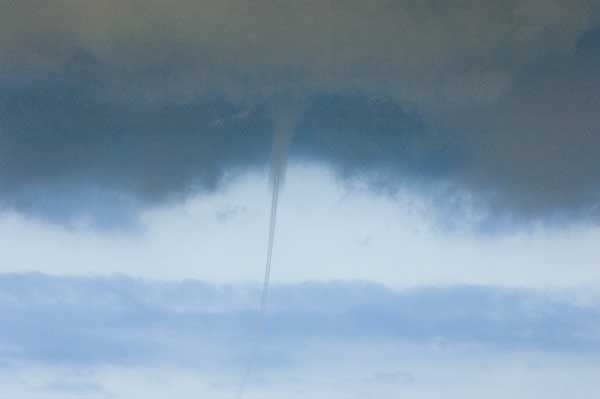
Early Sunday morning the 10th, I awoke and gazed out on the Pamlico Sound from my bedroom window. There I saw an ominous frontal system approaching. One cloud had a spike hanging from the bottom, and in a matter of minutes there was a slender waterspout spinning down to the water. It was however very brief, as I drove my truck north to follow its progress. As suddenly as it appeared, it vanished.

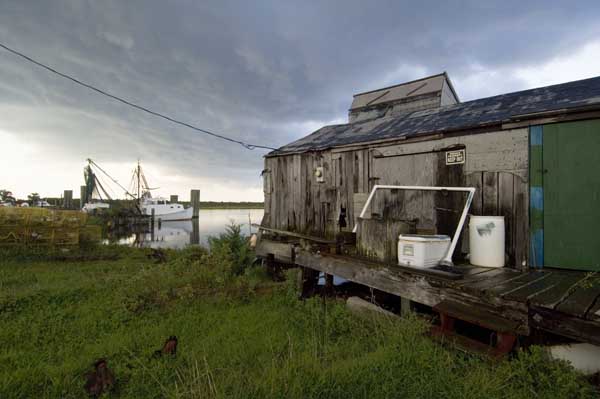
The storm clouds remained, and I drove around looking for dramatic images. I do this a lot spontaneously. Sometimes it pays off. Most of the time, it doesn’t. I pulled into an area locally known as the “Rodanthe Creek”. This is a place where much of the commercial fishing activity has taken place over the years. With the passage of time this usage has dwindled significantly. For years, I considered “the creek” to be a center of cultural activity. Most of the fish houses, where the daily catches came in, are gone. Now there is only one left, and it is utilized very little. I used to love taking pictures there, and today I made some shots that made me nostalgic. I could almost feel the excitement and activity of days gone by. Today I was glad to see a shrimp boat tied up to the dock.

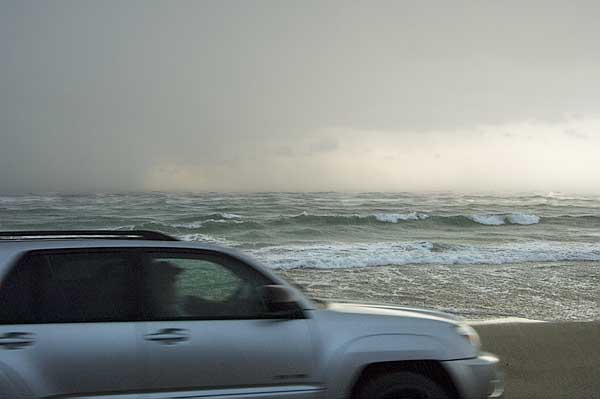
A short time later the weather cleared, only to have another heavy squall come down from the north, slightly offshore. I headed over ramp 23 to access the beach. There was a dramatic wall of rain moving south, and blowing a gale. With the adverse conditions, I couldn’t get out of my vehicle. I rolled down the window, took a quick shot. As I pressed the shutter a second time, a vehicle unexpectedly passed right in front of my picture. My initial reaction was that this “accidental tourist” ruined my beach scape.

I rolled up the window, and sat in my truck. The wind and rain intensified. Suddenly lightning bolts were striking all around me. Foolishly, I had a false sense of security in my truck. Then the hail stones began pelting the beach. That’s when I decided to head back home. It was just another day at the office.

To see my waterspout shots from 2005, follow this link.

http://outer-banks.com/halminski/waterspouts.cfm