Category Archives: Outer Banks

Spawning

This is a time of year when new life is born to maintain a continuance of species. Signs are all around us. Much of it is obvious, as in nesting birds or budding plants. But much of it we cannot see, unless we look closely. Take the eastern oyster, for example.

For as long as I’ve lived on Hatteras Island, oysters have been a fascination to me. Whenever I go collecting, it’s apparent that they grow in certain areas more than others. I notice that even in those more prolific spots, that the oyster population has generally been in a steady decline. This is attributed to over-harvesting, water pollution, parasites and lack of substrate material for new oysters to attach and grow.

Mature brood stock oysters emit egg and sperm into the water column, which in turn combine to produce eyed larvae, the beginning of becoming a true oyster. A scientific collection permit has allowed me to gather brooders for my own oyster garden spawning. I also donate collected brood stock to the aquaculture program at Carteret Community College and to the University of North Carolina Coastal Studies Institute at Cape Hatteras School.

Several years ago I attended an oyster conference in Morehead City, where I saw a number of scientists and people like myself looking for answers. It was here where I met Dr. Kemp. He runs the aquaculture program at Carteret Community College. A number of us got together and founded Shellfish Gardeners of North Carolina. We are interested in growing oysters, not only as a recreational activity, but also as a way to help the environment. We have had workshops to learn more about life cycles, water quality and to educate others.

For oyster gardening in eastern Pamlico Sound, Skip Kemp has been my mentor.

This has evolved into a network of people compiling and studying data. I collect water quality data for the Citizen’s Monitoring Network out of East Carolina University, and also compile information for the Oyster Spat Monitoring Project based at University of North Carolina in Wilmington.

Past data indicates that now is a prime time for local oysters to be spawning, so I have to keep a sharp eye out to see if there are any new oyster spat.

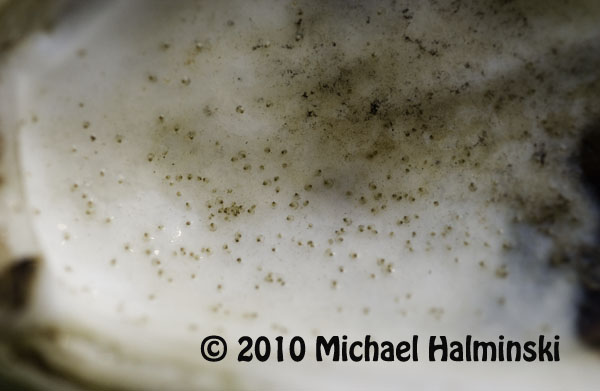
These eyed larvae have attached to an oyster shell and are 1 day old oysters.

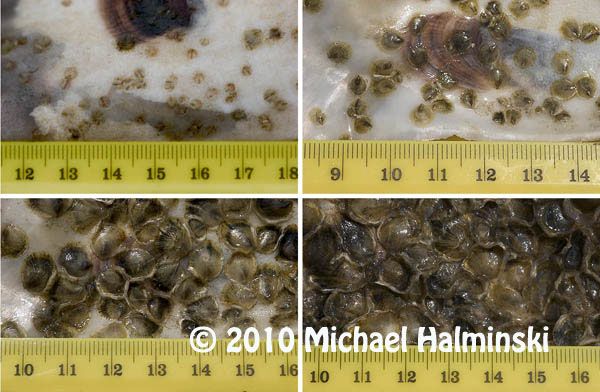
This composite image shows new oyster spat at weekly intervals beginning with 1 week old at the upper left and 4 weeks old on the lower right. The initial growth rates are dramatic. The ruler scale is in centimeters.


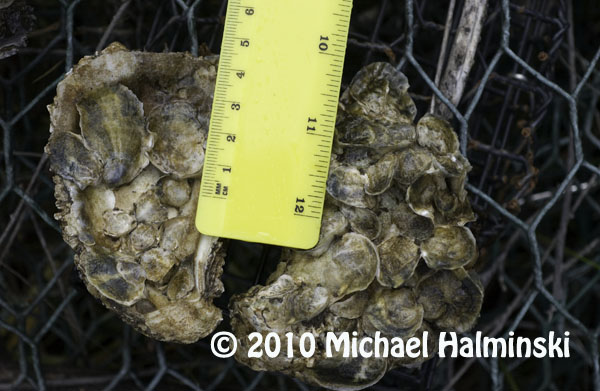
These are almost 5 months old.

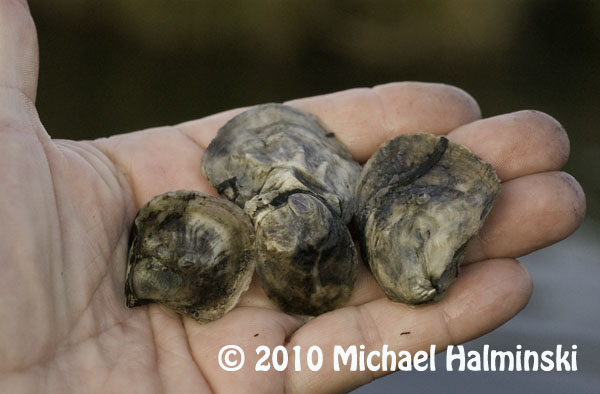
Yearlings can come in different sizes, depending on environmental conditions.


Unexpected Visitors

I love the nature and tranquility of my yard. The variety of birds that come throughout the year is amazing. Some fly to the feeder hanging in the garden. Others come to perch in the trees and bushes. Some do both. I’ve seen unusual birds like scarlet tanagers, baltimore orioles and bald eagles. I also get more usual sightings like cardinals, towhees and finches.

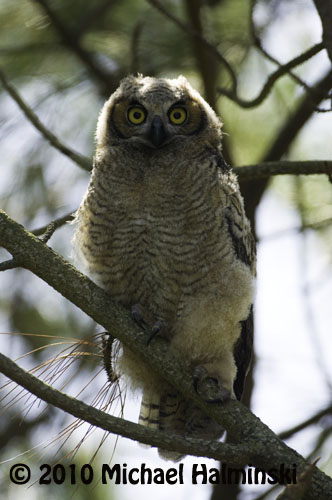
 A couple of weeks ago, my friend Steve dropped by. Like me, he’s an avid gardener, and sometimes we exchange seeds or ideas. As we were sitting next to one of my raised beds, discussing the merits of soil pH, there was a rustling in the pines. We looked up to see a feathery creature stumbling along the branches. It was a young great horned owl clutching a limb then jumping to another. We could hardly believe it. We all stared, checking out each other. The young bird was clicking it’s bill, and glaring at us with big yellow eyes. It was an amusing sight.

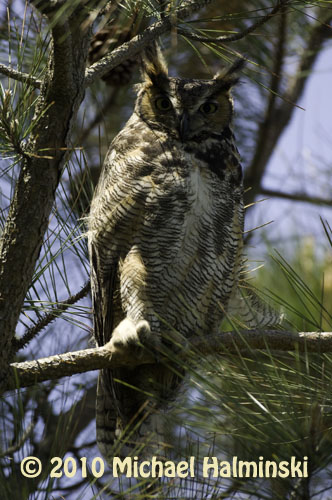
We looked for 20 minutes not realizing that we too were being scrutinized. Unbeknownst to us, there was an adult owl perched in an nearby tree, and it was watching us the whole time.   

The next few days I saw them again and again, and wondered why they would stay here. The juvenile, only a few months old, still had some downy plumage, yet was able to fly fairly well. A nest 30 feet up in a tree gave me a clue. Could it belong to them? It looked so small. 

I remembered the baby great horned owl that we rescued 2 years earlier, after it fell out of a nest. That youngster had been raised in a nest even smaller, but it worked. Well, sort of. I learned that great horned owls use nests built and vacated by other birds. Locally here on Hatteras, they nest in January or early February, long before most other birds are doing it.

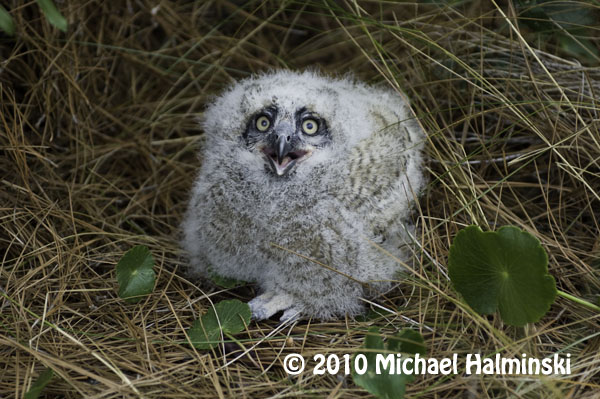
This 4-week old owl had fallen onto soft pine straw from a nest 25 feet high.

Now I’ve been watching these raptors for 3 weeks. During the day they roost nearly motionless in the branches. They move around a little, depending on the comfort zone. At times they get harassed by mocking birds, but other than that you’d never even know they were there. They blend in beautifully. If my theory about their nest is right, then they’ve been in my own back yard for 3 months without me knowing it.

The adult gets a morning snooze.

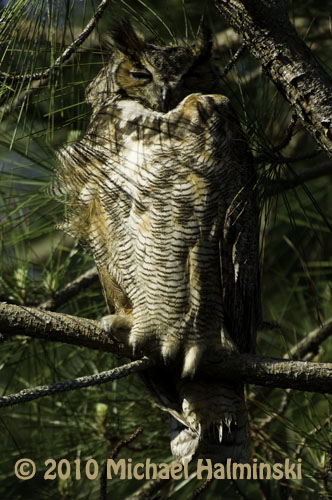
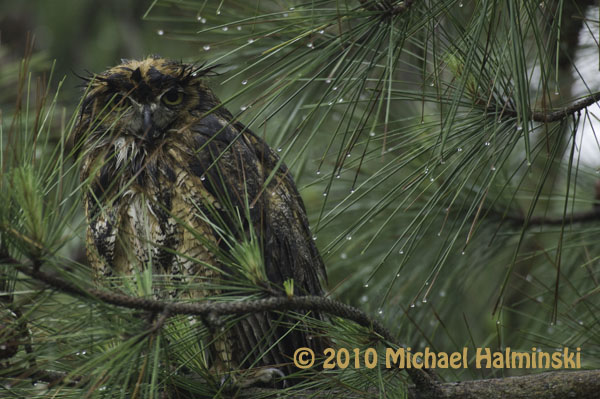
The adult after a long rainy night of hunting.

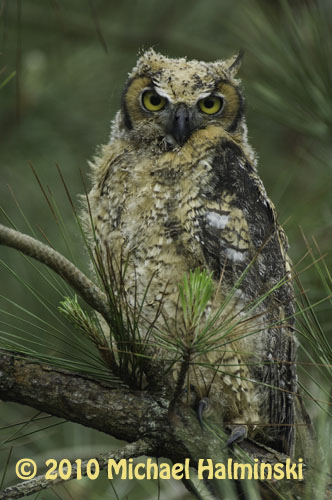
The juvenile is just getting its feathery horns.

Natural born killers, they are perfectly designed for what they do. At dusk they get active. They’re silent, stealthy fliers. At night, I’ve seen them perched on power lines, rooftops, on my osprey platform in the marsh, or at my neighbor’s fish house looking for prey. Then the next morning, I find them nestled stoically in the same group of trees. It’ll be interesting to see how long this continues.

Portsmouth Village Homecoming

For me, the most intriguing town on the Outer Banks is the village of Portsmouth. Situated on the northeast tip of Portsmouth Island, it played a significant role in local maritime history for well over one hundred years. It’s geographic location next to Ocracoke Inlet was important in making it a major port of commerce when wooden ships still sailed the seas. Deep draft ocean going vessels could offload goods there, and smaller boats would come from inland river towns to pick it up. From the 1750’s to the 1850’s, Portsmouth was a thriving seaport. According to an 1860 census, the town had a population of 685 residents.

But by then, things were beginning to change. A series of storms opened other inlets, and at the same time Ocracoke Inlet began to shoal. Shipping routes changed, commerce dropped off, and gradually the town dwindled to only a few people. With the death of Henry Pigott in 1971, the last man to live at Portsmouth, the last two residents, Elma Dixon and Marion Babb reluctantly left the island.

Today the 250 acre historic district of Portsmouth Village is a part of the Cape Lookout National Seashore. The remains of the town have been left intact and maintained.

Since 1992, the Friends of Portsmouth Island have sponsored a homecoming every 2 years. I went in 2008, and looked forward to this April 24, 2010 event. Again I was not disappointed. Here are a few things that caught my eye.

Descendants of village residents pose for a photographer in front of the Dixon/Salter house.

The Robert Wallace house.

The Dixon family cemetery.

The post office opens every other year for this event, including canceling postage stamps.

Ocracoke fisherman Gene Ballance demonstrates the art of net mending.

James Gaskill wears a device once used for fire-lighting waterfowl. He is also a commercial fisherman from Ocracoke.

At the old Coast Guard Station, Dave Frum explains the beach apparatus method for rescuing shipwreck survivors.

The Methodist Church was always a focal point of the community and still is.

88 year old Rudy Carter and Mil Hayes ring the bell to begin a church service. Rudy is a descendent of Henry Pigott, the last man to live at Portsmouth.

Get to the church on time if you want to get a seat.

Born in 1921, Dot Willis affectionally known as “Miss Dot”, is the last surviving resident that was born at Portsmouth Village. The light coming in the translucent windows of the church was very nice so I took the opportunity to speak with her, and make this available light portrait.

Back in the day, the flat-bottomed skiff was a preferred mode of transportation. These guys were fastening the bottom planks in a boat building demonstration.

Roy Willis from Stacy, NC was showing his waterfowl carvings.

Roy made and hunted over these green winged teal decoys last season.

The main tent provides seating for up to 500 people.

Then there’s the covered dish dinner with plenty for everyone. And the mosquitoes weren’t even that bad. If you go in 2012, I’ll see you there.

Group shot of attendees at the 2010 homecoming.


Jennette’s Pier

In 1990, I was privileged to be appointed to an advisory committee for the North Carolina Aquarium at Roanoke Island. I believe in the power of public education, and have remained with them ever since.

The North Carolina Aquariums are unique in that, North Carolina is the only state in the country to have 3 different and distinct facilities dispersed along the coast. Last week we hosted a joint advisory committee meeting, including advisors from Pine Knoll Shores and Fort Fisher. On a blustery Saturday morning, the group went to see the new Jennette’s Pier under construction. It is an amazing feat of engineering, and will be owned and operated by the North Carolina Aquariums.


For folks that love fishing piers or aquariums, it will provide a special one-of-a-kind experience, when finished. At 1000 feet long, it will have a 2-story pier house and alternative energy support. Ground breaking was in May of 2009 and completion is scheduled for May of 2011.

More information can be found at  https://www.ncaquariums.com/

A concrete piling rests on the south trestle, ready for installation.

This photo shows the pier house going up and piling arrangement from the work platform, or south trestle. 

This view of the pier construction from the 2nd floor of the pier house, shows the south trestle to the right. It is a temporary work platform, and will be removed.

This is the view from the pier house, facing west toward Sam & Omie’s Restaurant. Beyond is the bridge to Manteo.

Modern Day Shipwrecks

Often referred to as the Graveyard of the Atlantic, the ocean off the coast of the Outer Banks is  littered with hundreds, if not thousands of shipwrecks. Before modern modes of sailing, navigation and weather forecasting, commercial shipping was a more dangerous proposition than it is today.  Vessels transiting these waters however, still encounter problems.

I was reminded of this as I wrote a previous blog entry about the Sheila Rene running aground at Oregon Inlet. Similarly in October of 1977, as I was driving over the Bonner Bridge, south to Hatteras Island, I noticed a capsized trawler in the water next to the bridge. It was the fishing vessel Tosco. It was coming in the inlet with a 10,000 pound catch of flounder, when it ran aground and crashed into one of the bridge’s concrete piers. With a gaping hole in the hull, it sank right there on the spot. The boat was an estimated $100,000 loss, and the bounty of fish was also lost.

The Tosco at Oregon Inlet in 1977.

When most people think of shipwrecks along our shores, they think of the wooden sailing ships of the distant past. One of the last such wrecks was that of the GA Kohler. Built in Delaware in 1919, it was a 4-masted schooner, just over 200 feet long. Washing up in a 1933 storm, it is significant as marking the end of an era. It lay upright on the beach and was stripped in the war effort for materials, and subsequently burned. Some of the old artifacts, like wooden timbers, compass and even dinnerware, are in local homes today. The remains of the GA Kohler are currently buried beneath the beach sands near Ramp 27, but on rare occasions the remnants are uncovered by the ocean.

This photo from 1989 shows my friend Robin Gerald inspecting the stern section of the GA Kohler.

Since then, maritime mishaps have become less likely, and rare. Most of the activity on coastal waters nowadays pertains to sport or commercial fishing boats, and private yachts, among others. 

One exceptional event though, occurred in January of 1976 . It was during a freezing northeaster. I awoke in a bitter cold mobile home and couldn’t open the north door to get out. It had been frozen shut during an ice storm. The entire north side of the trailer was coated solid with 2 inches of ice. Once I got outside, I looked toward the beach and saw a sight that I could not believe. A 500 foot World War II liberty ship, Betelgeuse was washed up and towering on the beach. The moth-balled ship was being towed by a tug offshore when the storm hit with a vengeance. The tug, unable to handle the situation was forced to cut it loose. The ship sat on the beach for over a month until salvagers managed to move it, but not before Mac Midgett tied a line to it, claiming salvage rights. It was said that he made a few thousand bucks for his effort.

The World War II Liberty Ship washed in during an ice storm in 1976.

1987 was a banner year for stranded fishing boats. Here the Sweet Lady sits on the beach at Rodanthe, just yards from the pier. It was abandoned offshore during a storm as the crew evacuated via Coast Guard helicopter. It came short of hitting the pier, and was eventually salvaged.

The Hard 8 came ashore in “the hook” at Cape Point that same year.

When the Miss Manhattan washed ashore in 2000, it had hit the Rodanthe pier, and was dismasted in the process. It was salvaged.

The Sly Fox came ashore on Pea Island around Christmas of 2004… not so sly any more.

They say that one problem on the water, especially during severe weather, can turn into multiple problems very quickly. With distressed vessels in the Graveyard of the Atlantic this seems to be a common denominator.