Author Archives: j0jgvm89bj

My Friend David

In 1985 there was a photographer visiting the Outer Banks named David Harvey. He was working on a story for National Geographic Magazine, a publication that for me was a great photographic inspiration.

One of the first stories circulating about him was concerning Hurricane Gloria bearing down on the coast. It was a category 5 storm with winds in the range of 150 miles an hour. After seeing nearly EVERYONE evacuating Hatteras Island, I decided to go myself. To this day, it’s the only storm that ever made me leave the island.

Of course, David and writer Charlie Cobb decided that in the interest of journalism, they would ride it out, but that’s another story. I must say that I was very impressed, and really wanted to meet him.

That day came, and we were both on a foggy beach at Cape Point. There was a commercial fishing crew with a haul seine rig, and I was in awe just looking at the photography equipment in his vehicle. At the time, I could barely afford the film and processing for my own work. He was kind enough to invite me along on his shooting for the rest of the day. We went to Hatteras Village where we saw some other commercial fishermen, including Outer Banks legend, Captain Ernal Foster.

He must have “worked” on that assignment for 2 years off and on. I showed him some places that were special to me, and a few of those shots were published in the article that came out in the October 1987 issue. That made me feel good.

With his travels continuing around the globe shooting and teaching, he always comes back to the Outer Banks.

Contrast by Fire

This image was not a part of my recent assignment, but since I was going around the shoreline, I got to see some of the effects of the wildfires on the area. With rich layers of peat underground, the fires can continue to burn undetected. For this reason, large sprinkler heads soak water into the ground that has already burned. What a stark contrast to the beautiful forests that I had seen just minutes earlier.

Cypress Trees at Lake Phelps

Last Friday I shot another magazine assignment. This time I drove inland to visit North Carolina’s second largest natural lake. Lake Phelps is a part of Pettigrew State Park. It encompasses over 16,000 acres and is surrounded by some beautiful old growth forest. This image was made at a very scenic spot called Moccasin Overlook. Cypress trees are found around much of the lake, but here one also notices an abundant amount of Spanish moss. It hugs the trees as if someone has come in and wrapped it all around, like garland on a Christmas tree.

Pocosin National Wildlife Refuge is nearby, and has been fraught with wildfires for the past several weeks. There’s been more than 60,000 acres burned. In order to control the flames, firefighters have been pumping water from the lake, enough to bring the water level down several inches. These Bald Cypress normally have water all around them.

Methodist Church – prints available on request

Among the first images that I made in the early morning of May 26th, on the Portsmouth Village assignment, was the old Methodist Church. Probably the most prominent building in the historic district, it is well restored and maintained. One of the most salient features of the church is it’s list to the right, as a result of exposure to winds and storms. Looking under the building, one can see the old ship timbers that make up the floor framing. Interestingly, many old buildings on the Outer Banks were constructed from salvaged shipwrecks.

The Henry Pigott House

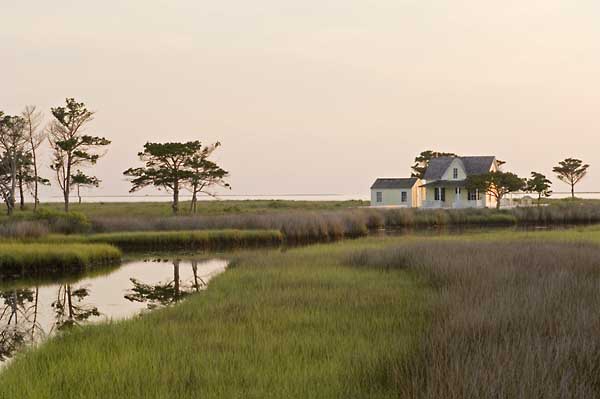
Another shot from my trip to Portsmouth Village, the Henry Pigott house image was taken just minutes prior to the Doctors Creek photo in my previous post. The image shows Doctors Creek looking in the opposite direction. The low light of sunrise was fleeting quickly, and didn’t last very long before turning to bright sunshine. Fortunately as that occurred, the mosquitoes became somewhat less voracious as well.